Agroecology Criteria Tool
Last updated 3 November 2025
The Agroecology Criteria Tool (ACT) methodology is grounded in Gliessman’s analytical framework of the five levels of food system change and is aligned with the FAO’s 10 Elements of Agroecology.
Agroecology transformation
The methodology analyzes a continuum of a transition rather than a binary analysis and a clear definition.
According to Gliessman’s 5 levels, a system is in line with basic agroecological principles if Level 3 has been reached.
Level 4 and 5 are going beyond production and focus on socio-economic aspects such as re-establishing connections between growers and eaters and responsible governance.
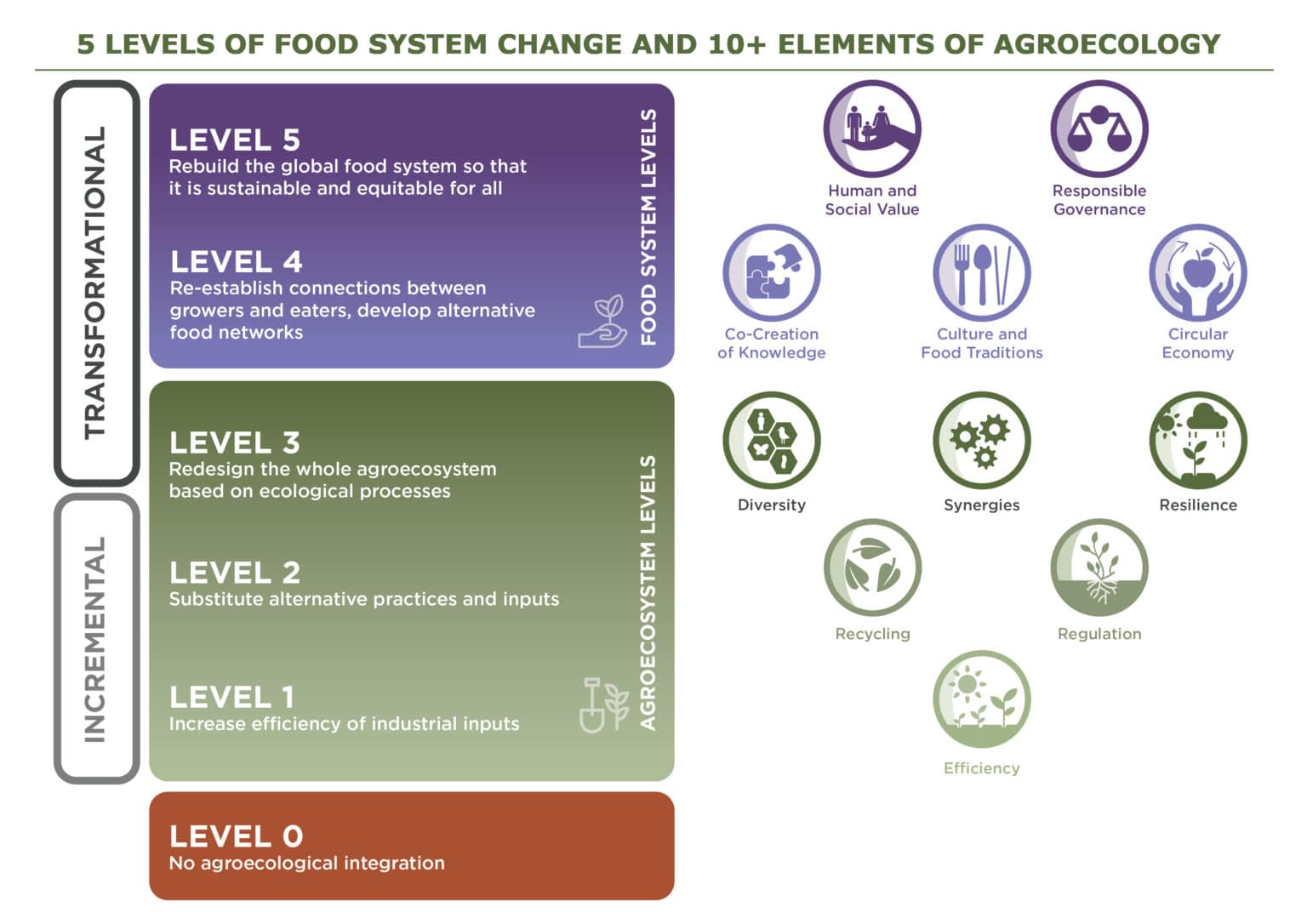
Agroecological transitions can be initiated at multiple entry points, whether at the farm, landscape, market, or policy levels. The 5 levels of food system framework should be used to locate activities rather than as a pathway for change from 1 to 5. Nonetheless, for initiatives focused on the farm-level to be identified as agroecological, they must engage with level 3 change. Engage ment solely with level 1 and/or 2 indicates initiative engaged with incremental change rather than agroecological transformation. Likewise, initiatives engaged with level 4 and/or 5 may be identified as ‘social enablers’, and as ‘systemic’ if engagement with level 3 is also apparent.
For more detail on these levels, please refer to the Agroecology Criteria and Coding Procedure.
How can results from ACT be interpreted?
How can ACT be used?
As a monitoring, evaluation, and design tool, ACT is available as a downloadable Excel file. It can be used to assess the extent to which an initiative supports different dimensions of agroecological change. Using ACT in this way enables greater accountability and provides a baseline for determining how effectively an initiative contributes to agroecological transitions, while helping ensure that the term is not misused or co-opted.
Beyond identifying activities, the tool also highlights which levels of food system transformation the initiative engages with and can help identify areas for future development. ACT can be used internally by organisations to assess their initiatives, or by external stakeholders—for example, to compare different initiatives, increase transparency, and provide recommendations for improvement. It can also be used to evaluate whether an initiative’s original objectives are aligned with the activities it delivers.
The visualisation of results provided by ACT differs depending on whether you are assessing a single or multiple initiatives. Deeper analysis of multiple initiatives can be achieved by comparing the individual results of each initiative.
The results produced by ACT are context specific. Rather than aiming at a universal goal, or full scores, ACT is best used to assess an initiative within the context of what is both feasible and desirable. This is important given the inherent trade-offs that agroecology entails. For example, cover crops can be used for soil conservation, as green manures, as livestock feed, or for biochar. Depending on the objectives on an initiative, it may not be feasible, nor desirable, to meet criteria for all of these uses of cover crops.
Comparisons between multiple initiatives must reflect the contexts in which they exist. For example, in contexts where food systems are already localized it is unlikely that activities related to ‘re-localising’ food systems are to be found. It would therefore be inappropriate to compare such an initiative with another operating in a context where strengthening local food webs is a priority. Geographic or other boundaries may therefore be useful.
ACT does not evaluate outcomes or impacts of activities. It is recommended that a mixed methods approach is utilized if such results are desired.
Criteria selection is binary (yes/no) and therefore does not indicate quality or diversity of agroecological activities. This means that positive results do not exclude possibility for further development. Likewise, when comparing multiple initiatives users must rely on any notes that have been entered in the tool to distinguish the nuances of how each initiative engages with criteria.
Criteria inclusion may be affected by user subjectivity. It is recommended that analyses are internally and externally reviewed to minimise biases. Likewise, it is recommended to justify how particular definitions or concepts are used. Additionally, data gaps should be filled via interviews to confirm absent criteria.
Limitations of ACT
Agroecology Criteria Tool
Download
Choose a project method
All BidCarbon Standard Scheme projects are required to choose a project method and collaborate with the ACT to execute their project. ACT is a comprehensive tool specifically designed to evaluate the multidimensional performance of agroecological systems across various sustainability dimensions.
Tool for Agroecology Performance Evaluation
While the TAPE provides the theory, background, and proposed approach to measure performance and assess agroecology in terms of metrics and methods.
Report on Sustainable Performance
The BidCarbon Standard Scheme project proponent submits an annual sustainability performance report for stakeholder review.
Learn more

HELPFUL LINKS FOR
TM